Homemade Tofu That’s Firm, Not Crumbly: Soy‑to‑Water Ratios, Coagulant Choices (Nigari vs. Gypsum vs. Lemon), and Pressing Time for Silky or Extra‑Firm Blocks
RecipeSimpli
Why homemade tofu sometimes turns out crumbly (and how to fix it)
Crumbly tofu is usually not a “bad recipe” problem—it’s a process-control problem. When tofu falls apart, the most common culprits are:
- Too little protein in the soymilk (weak curd network): caused by over-dilution (too much water), under-extraction (short blending/cooking), or low-quality/old soybeans.
- Over-coagulation (curd shatters into tiny grains): too much coagulant, added too fast, or stirred too aggressively.
- Coagulating at the wrong temperature: too hot can make coarse curds; too cool can make fragile curds that never set firmly.
- Rough handling and premature pressing: stirring hard after coagulant goes in, cutting curds, or pressing before curds have finished knitting.
- Pressing mismatch: pressing too hard too soon squeezes moisture and fat out before the curd network stabilizes; pressing too little yields a soft block that breaks when handled.
The good news: once you control soy-to-water ratio, coagulant type and dose, and pressing time/pressure, tofu becomes repeatable. Think of it like making yogurt or cheese—structure comes from protein chemistry, and the “feel” comes from water management.
This guide gives you reliable ratios, dosage rules, temperature cues, whey-clarity tests, and a pressing chart to dial in textures from delicate silken to extra-firm.
A quick cultural and culinary context (why coagulants differ)
Tofu (dòufu) emerged in China more than a millennium ago and spread widely across East and Southeast Asia, taking on local styles. Coagulants vary by region because they reflect local resources:
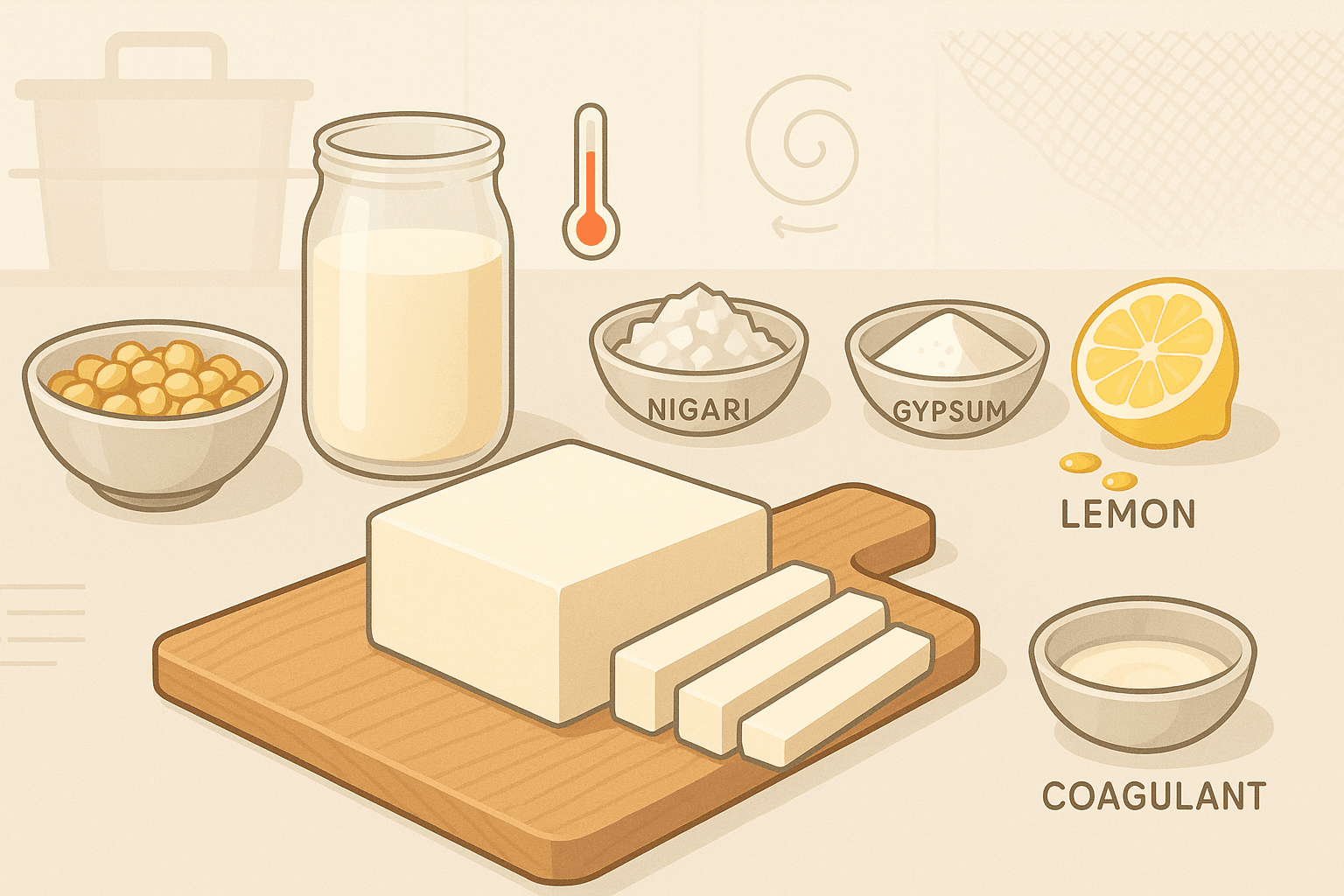
- Nigari (bittern): traditionally the mineral-rich liquid left after sea salt crystallization, common in Japan for silky-yet-springy tofu with a subtle sweetness.
- Gypsum (calcium sulfate): historically common in Chinese tofu-making; produces a tender, smooth curd and adds calcium.
- Acid coagulants (lemon juice, vinegar, glucono delta-lactone/GDL): acidifies the soymilk to the proteins’ isoelectric point, causing coagulation. Lemon/vinegar are accessible but less predictable; GDL is very predictable and common in commercial silken tofu.
All of them can make excellent tofu. The key is matching coagulant chemistry to the texture you want and dosing it with restraint.
The foundation: soymilk strength (soy‑to‑water ratios that actually work)
Tofu quality starts with soymilk. If your soymilk is thin, no coagulant can “force” a strong, cohesive curd—at least not without turning it gritty.
Recommended soy-to-water ratios (dry soybeans)
These ratios refer to dry soybeans to total water used for blending/extraction (not including soaking water that gets discarded).
| Target tofu style | Dry soybeans | Water (by weight) | Ratio (soy:water) | Notes |
|---|---|---|---|---|
| Silken / very tender | 100 g | 900–1100 g | 1:9 to 1:11 | Higher water gives softer gel; better with GDL or gentle nigari. |
| Medium / standard block | 100 g | 800–900 g | 1:8 to 1:9 | Good all-purpose starting point for nigari or gypsum. |
| Firm / extra-firm | 100 g | 650–800 g | 1:6.5 to 1:8 | Stronger soymilk yields cohesive curd and better pressing resilience. |
Practical starting point: If you want tofu that’s firm but not crumbly, start at 1:8 (100 g soybeans to 800 g water).
Why ratio matters (the science in plain language)
Soy proteins (mainly glycinin and β-conglycinin) form a network when coagulated. Water is trapped inside that network. If the soymilk is too dilute, the network is sparse and breaks easily. If it’s too concentrated, it can set too fast and become coarse unless you handle it gently.
Bean choice, soaking, and extraction: small steps that change texture
Choose beans with protein potential
- Fresh, food-grade soybeans matter. Old beans can oxidize and extract poorly.
- Many tofu makers prefer non-GMO soybeans for tradition and marketing, but for home texture, the bigger factor is freshness and storage.
Soaking rules (for even grinding and better yield)
- Soak 8–12 hours in cool water (or 6–8 hours in warm conditions).
- Beans should split easily between fingers.
- Drain and rinse well.
Undersoaked beans grind unevenly and can reduce protein extraction, increasing the chance of weak curd.
Extraction technique: blend thoroughly, then cook properly
A reliable home workflow:
- Blend soaked beans with measured water until very smooth (in batches if needed).
- Cook the slurry (bean purée + water) to fully denature proteins and inactivate enzymes.
- Strain through a nut milk bag/cloth to get soymilk.
Some methods strain before cooking; others cook before straining. Either can work, but cooking the slurry reduces raw-bean flavor and improves protein behavior.
Key cooking cue: bring the slurry/soymilk to a controlled simmer (watch for foam). A common target is 95–100°C (203–212°F) with a brief simmer, stirring to prevent scorching.
Coagulants: nigari vs gypsum vs lemon (how they behave and what to expect)
Coagulation is the moment tofu is “born.” The goal is curds that are big, tender, and cohesive, not granular.
1) Nigari (magnesium chloride): silky, sweet, springy
What it does: Magnesium ions help proteins link into a smooth gel with good elasticity.
Pros
- Often yields a silky yet resilient tofu.
- Classic flavor and texture for Japanese-style tofu.
Cons
- Easy to overdose; too much can make curds brittle and the tofu slightly bitter.
- Different nigari products vary in concentration.
Dosage rule (starting point):
- For 1 liter soymilk, start with 2–3 g magnesium chloride (MgCl₂).
- If using liquid nigari, follow label strength; many home cooks start around 1–2 teaspoons per liter, but this varies widely—treat it as approximate.
2) Gypsum (calcium sulfate): smooth, tender, great for blocks
What it does: Calcium ions create strong protein cross-links and a cohesive curd. Gypsum tends to be forgiving and is widely used in traditional Chinese tofu making.
Pros
- Gentler flavor than poorly dosed nigari.
- Often produces a smooth, tender, cohesive block.
- Adds calcium.
Cons
- If not dissolved well, can leave chalky specks.
Dosage rule (starting point):
- For 1 liter soymilk, start with 3–4 g calcium sulfate (CaSO₄·2H₂O).
3) Lemon juice (or vinegar): accessible, but less predictable
What it does: Acid lowers pH toward soy proteins’ isoelectric point (around pH ~4.5), causing them to aggregate.
Pros
- Pantry-friendly.
- Works when mineral coagulants aren’t available.
Cons
- Acid strength varies (lemons differ; vinegars differ).
- More likely to produce smaller, grainier curds, which can translate to crumbly tofu.
- Flavor can be more noticeable.
Dosage rule (starting point):
- For 1 liter soymilk, try 20–30 g (about 1.5–2 tablespoons) lemon juice, diluted in equal water.
- Add gradually; stop when curds form and whey begins to clear.
If your goal is “firm, not crumbly,” mineral coagulants (gypsum or nigari) are usually easier to control than lemon.
Temperature cues: when to add coagulant (and why it’s so important)
The temperature of the soymilk at coagulation strongly affects curd size and tenderness.
Target coagulation temperature
- 70–80°C (158–176°F) is a reliable range for many home tofu processes.
- Hotter (above ~85°C/185°F) can set curds quickly and coarsen them.
- Cooler (below ~65°C/149°F) may yield fragile curds that don’t knit well.
Practical cue if you don’t have a thermometer
- Soymilk is hot but not boiling.
- Steam rises steadily.
- A clean spoon dipped in and lifted feels very hot to the touch, and you can’t comfortably hold the spoon bowl with your finger.
A thermometer is worth it for repeatability, but you can still succeed with consistent cues.
The two “gentle” moments that prevent crumbly tofu
1) Dissolve the coagulant completely
Undissolved particles create local “hot spots” of coagulation, producing gritty curds.
- Dissolve powder coagulants in warm water (not boiling) until fully dispersed.
- For gypsum especially, stir well; it suspends more than it dissolves.
2) Stir less than you think
Overstirring after adding coagulant breaks forming curds into tiny pieces. Those tiny curds don’t knit well in the mold—classic crumbly texture.
Gentle stirring method:
- Turn off heat.
- Let soymilk cool into target range (70–80°C).
- Add half the coagulant solution in a thin stream.
- Stir 2–3 slow, deep strokes (like drawing a large “S” through the pot).
- Wait 60–90 seconds.
- Add remaining coagulant gradually where liquid looks most milky.
- Do 1–2 slow strokes at most.
- Cover and rest 10–15 minutes.
Rest time is not optional. During this period, proteins continue to link and the curds “heal.” Pressing too early interrupts this knitting.
Whey clarity tests: how to know when you’ve added enough coagulant
Home tofu makers often ask, “How do I know it’s done?” The most practical answer is the whey.
What you want to see
- Curds gather into soft clouds.
- The surrounding liquid (whey) turns yellowish and clearer than the original milk.
Signs you need a little more coagulant
- Whey stays uniformly white like milk.
- Curds are very fine and don’t clump.
Add a small amount more coagulant solution (a teaspoon at a time), wait 1 minute, and reassess.
Signs you added too much (or too aggressively)
- Curds become tiny, gritty granules.
- Whey separates fast but curds feel dry or brittle.
- Finished tofu tastes slightly bitter (common with excess nigari).
To prevent overdosing, always hold back 10–20% of your coagulant solution and creep up slowly.
A reliable base recipe (1:8 ratio) with dosage options
This makes one medium block (yield varies with beans and pressing).
Ingredients
- Dry soybeans: 200 g
- Water for blending/extraction: 1600 g (1.6 L)
- Coagulant (choose one):
- Nigari (MgCl₂): 4–6 g dissolved in 80–120 g warm water
- Gypsum (CaSO₄): 6–8 g dispersed in 100–150 g warm water
- Lemon juice: 40–60 g lemon juice + 40–60 g water (start low and add gradually)
Equipment
- Blender
- Large pot
- Nut milk bag/cheesecloth
- Thermometer (recommended)
- Tofu mold + liner (or colander lined with cloth)
- A way to press (weights, a tofu press, or a plate + jars)
Method overview
- Soak beans 8–12 hours. Drain, rinse.
- Blend beans with measured water until extremely smooth.
- Cook the slurry, stirring to prevent scorching, until it reaches near-boil; simmer briefly.
- Strain through cloth, squeezing carefully (hot!). You now have fresh soymilk.
- Reheat soymilk to 70–80°C (158–176°F).
- Add coagulant gently in stages (as described above).
- Rest covered 10–15 minutes.
- Ladle curds into lined mold gently. Let drain 3–5 minutes.
- Press according to desired texture (see chart below).
- Chill in water 30 minutes for best slicing and resilience.
That final water chill helps the block set and makes it less prone to crumbling when cut.
Pressing: the texture control lever (with a practical chart)
Pressing determines how much whey remains trapped and how tightly curds knit into a sliceable block.
Two important principles:
- Start lighter, then increase. Heavy pressure too early forces curds apart and pushes fines through the cloth.
- Time matters as much as weight. A moderate press for longer often beats a heavy press for short time.
Pressing chart (home-friendly, scalable)
Assume a mold making a block roughly 10–12 cm square. “Weight” refers to total load on top of tofu.
| Style | Drain before pressing | Press weight | Press time | Result |
|---|---|---|---|---|
| Silken-style (molded, not true silken) | 5–10 min | No press or 0.5–1 kg | 10–15 min | Very tender, custardy, fragile. |
| Soft | 5 min | 1–2 kg | 15–25 min | Soft, moist, gentle crumble; good for mapo tofu. |
| Medium / regular | 5 min | 2–4 kg | 25–40 min | Sliceable, good for stir-fries. |
| Firm | 5 min | 4–6 kg | 45–70 min | Holds shape, pan-fries well. |
| Extra-firm | 5 min | 6–10 kg | 75–120 min | Dense, chewy, great for grilling. |
How to improvise weights: water-filled jars, a cast-iron pan, or a pot of water on a plate. Keep the load centered.
A simple two-stage press (recommended)
- Stage 1: 2–3 kg for 15 minutes (gentle knitting)
- Stage 2: increase to target weight for remaining time
This reduces cracks and crumbles because the curd has time to consolidate.
Matching coagulant to texture goals
If you want silky but sliceable
- Use nigari at the low end of dosage.
- Coagulate closer to 70–75°C.
- Minimal stirring; longer rest.
- Press lightly.
If you want firm blocks that still feel smooth (great “everyday tofu”)
- Use gypsum or a gypsum-forward blend.
- Coagulate 75–80°C.
- Press medium to firm.
If you want extra-firm for frying/grilling
- Start with slightly stronger soymilk (1:6.5 to 1:7.5).
- Use gypsum or carefully dosed nigari.
- Press longer rather than dramatically heavier.
If you only have lemon
- Dilute it and add slowly.
- Keep temperature in range; avoid boiling hot.
- Expect a slightly grainier curd; compensate with gentle handling and a longer rest before pressing.
Troubleshooting: symptoms, causes, fixes
Problem: tofu is crumbly and breaks when slicing
Likely causes
- Soymilk too dilute
- Overstirring after coagulant
- Overdosing coagulant (especially nigari)
- Pressed too hard too soon
Fixes
- Move ratio toward 1:7–1:8
- Stir only a few slow strokes
- Reduce coagulant 10–20%, add in stages
- Use two-stage pressing
- Chill block in water before slicing
Problem: curds never fully separate; whey stays milky
Likely causes
- Too little coagulant
- Coagulating too cool
- Soymilk not cooked/denatured enough
Fixes
- Add small increments of coagulant solution
- Bring soymilk to 75–80°C
- Ensure a proper cook to near-boil before coagulation
Problem: gritty, sandy curds
Likely causes
- Too much coagulant dumped in at once
- Coagulant not dissolved
- Temperature too high
Fixes
- Add gradually; minimal stirring
- Dissolve/disperse fully
- Coagulate at 70–80°C, not boiling
Problem: tofu tastes bitter or metallic
Likely causes
- Too much nigari
Fixes
- Reduce nigari dose; consider gypsum
- Rinse finished tofu briefly and store in fresh water
Storage and handling: keep it firm, not fragile
- Cool tofu in cold water 30–60 minutes after pressing.
- Store submerged in fresh water in the fridge; change water daily.
- Use within 3–5 days for best texture.
For cooking, treat fresh tofu gently:
- Slice with a sharp knife.
- Support slices with a spatula.
- For frying, pat dry and consider a light starch coating.
A practical “repeatability” checklist
If you want to make tofu that’s consistently firm and cohesive, repeatability is everything. Keep notes on:
- Bean brand and soak time
- Soy:water ratio
- Soymilk volume after straining
- Coagulant type and grams used
- Coagulation temperature
- Rest time
- Press weight/time
Even one or two batches of notes will let you dial in your perfect block.
Suggested starting formulas (quick picks)
Most reliable for firm, not crumbly (recommended)
- Ratio: 1:8
- Coagulant: gypsum 3–4 g per liter soymilk
- Coag temp: 75–80°C
- Rest: 15 min
- Press: 4–6 kg for 60 min (two-stage)
Silky, delicate, Japanese-style
- Ratio: 1:9
- Coagulant: nigari 2–2.5 g per liter
- Coag temp: 70–75°C
- Rest: 15 min
- Press: 1–2 kg for 15–25 min
Extra-firm, grill-ready
- Ratio: 1:6.5–1:7.5
- Coagulant: gypsum 3.5–4.5 g per liter
- Coag temp: 78–80°C
- Rest: 15 min
- Press: 6–10 kg for 90–120 min
Closing: tofu as a controllable craft
Homemade tofu feels magical because it transforms simple beans and water into a block you can slice, sear, and savor. But it’s not magic—it’s controllable chemistry. Strong soymilk (right ratio), the right coagulant in the right dose, careful temperature, minimal stirring, and a press schedule that matches your target texture will give you tofu that’s firm without being crumbly, and tender without falling apart.
Once you find your baseline—say, 1:8 soymilk with gypsum at 3–4 g/L and a one-hour firm press—you can confidently tweak one variable at a time. That’s how you go from “it worked once” to “I can make my tofu any way I want.”
References and further reading (for the curious)
- Harold McGee, On Food and Cooking (protein coagulation concepts and culinary science context)
- Tofu and soymilk production literature on soy protein denaturation and ionic coagulation (food science texts and extension publications)
- Traditional tofu-making practices from Japanese (nigari) and Chinese (gypsum) culinary traditions, widely documented by tofu artisans and regional cookbooks